Lawrence's sense of the dramatic, and the tragic, in his own life and in the "revolt in the desert" must of course be difficult to either corroborate or discard. His work, and indeed his own myth, has become so intertwined with the conflict between the Arabs and the Turks that any dissenting view must address his weighty recounting. Yet perhaps the work's greatest strength is its thorough subjectivity. Lawrence makes no attempt to see the conflict and the issues which underpin it disinterestedly. It is because he cared so much for the Arab revolt, and similarly because he was so critical of both his own effectiveness and the appropriateness of his role, that this very personal recounting succeeds so admirably in conveying not only what the conflict was, but what it meant.
A sense of both the dramatic and the tragic in human affairs requires an accounting for the humane element. When a story - whether real, fictive, or somewhere in between - cannot arouse a reader's passions, then it can never transport a reader beyond his or her own confines. Yet when the personal element is felt, when the battle is joined not simply in some by-gone time, but in our own minds, then history steps out of the shadow of memory and is present in all its immediacy. Lawrence tells us that there is both right and wrong in the world, and that both the best and the worst of us transcend each and it is hardly certain which is which. The confusion of the modern predicament seems to be the awareness of that good, and yet the simultaneous awareness that, even on our best days, we fail to measure up to our own standards. Our common humanity with Lawrence's Arab compatriots, whom he alternately paints as wise and foolish, robust and fragile, faint-hearted and exceedingly bold, is in striving with and against the recognition that we are shadows on a vast landscape. But whereas the Howeitat and the Beni Salem may have been buttressed by faith and the certain absolutes of an unforgiving desert, Lawrence is thoroughly modern: riven and divided against himself.
Throughout, Lawrence is shadowed by himself and his own doubts, in the end we wonder if he was satisfied with his role in the Arab Revolt. Seven Pillars of Wisdom is sweeping, thorough, and at times seems as barren as the Nefud. Lawrence's gift to his time was bringing the Arab Revolt to the front of western consciousness. His continued gift is reminding us that beauty and tragedy are little more than shades of one another. We hold each of these in our hearts and attempt to make sense of them every day.
Saturday, August 30, 2014
Wednesday, July 23, 2014
At Canaan's Edge: America in the King Years, 1965-1968
The final years of the life of Rev. Dr. Martin Luther King, Jr. were years of almost, of in-between. Take what the mass of America knows about Dr. King, about the timeline of his life, and it likely reads from the Montgomery Bus Boycott (1955-56), to varying civil rights protests across the South, perhaps in Selma, Alabama, St. Augustine, Florida, and Albany, Georgia, and then on to 1963 with his Letter from a Birmingham Jail and the March on Washington. History in the American consciousness tends to marginalize King after his famous "I Have a Dream" speech. Rather, the assassination of President Kennedy, followed by President Johnson's Civil Rights and Voting Rights legislation, and then the slow unfurling of the Vietnam War, often overshadow King's final years of witness to the transformative power of nonviolence. In a society so riven by, and focused upon violence, both at home and abroad, King's steadfast devotion to nonviolence struck many as antiquated, adequate for the initial stages of protest for rights, but unable to secure the true place of equal citizenship for black Americans. While white America might imagine that legislation in the 1960s put an end to the Civil Rights Movement, that the fierce urgency of the moment became subsumed to the clear advancement of blacks and other minority groups, this gloss ignores the continued, illegal, segregation in the North and South, and efforts and yearnings of Dr. King and other civil rights advocates well into the late 1960s (and beyond).
For it was after the early successes of civil rights that the issues and messages of the time become more difficult to understand. To most modern Americans, denying people the right to public services and accommodations, to the right to vote, to sit where they want to on buses, to swim in the local swimming pool, seem like the absurdities of a bygone day. These are tangible, measurable, visible disparities between two Americas that can be pointed to and commented upon through the most cursory of glances; inequalities fit for a grade school lesson. Yet the Civil Rights Movement did not end with the Voting Rights Act, nor with the death of Dr. King and the slow undoing of Resurrection City in the Washington D.C. summer rains of 1968. Taylor Branch's final installment of his three part history of the Civil Rights Movement traces the last years of Kings life, after the limited success of voting rights and first official steps in Washington, the South, and some northern cities. Kings final years - when he maintained a firm commitment to equal rights, while broadening that concept to encompass not just the ballot and the bus, but the right of each person for self-determination, freedom from economic fear, and violent repression - these are years less easy to recount. King propounded a broader critique of American society, not only as unchristian, but as unworthy of the country's founding principles. These principles, he believed, must encompass not simply the positive freedoms of property and suffrage, but also include freedoms from the unexplored, darker side of the public sphere. Freedom from want, freedom from fear, freedom from violence. These freedoms are at once more illusory and, for so many Americans, more embedded in the root of living an American life. King sought out these roots, to grab them where they were most deeply nurtured and rip out the foundations of injustice that so many of us take for granted.
Taylor Branch's final volume is surely the most difficult to absorb and appreciate for its contemporary relevance. The birth of the Civil Rights Movement and its early victories are, in a sense, an easier story to tell. Such stories relate a history of an awakened consciousness, of battles won and lost, of people who stood for and stood against the overlooked among us. Between peaceful protests and violent actions, freedom and oppression contested, hopes and fears - from both sides of the fence - faced-off and a narrative emerges. The final years of Dr. King's life are more difficult to grasp because the very contradictions he faced are many of the contradictions and shortcomings present still. The Civil Rights Movement as recounted in grade school history has a tidy narrative arc, with certain lessons about the past. More difficult by far are the latter years of the movement, or the beginnings of another phase and struggle, a battle which is still being joined today. Those latter years remain embodied in the American present. Though King's life was cut short by an assassin's bullet, we cannot forget that the lessons of his final years are of vast importance for us all. King sought to address the foundations of inequality in America, and bring to light the struggle which characterizes the lives of so many. This is a more difficult story to tell because it remains a story still enacted. King's struggle remains our own.
For it was after the early successes of civil rights that the issues and messages of the time become more difficult to understand. To most modern Americans, denying people the right to public services and accommodations, to the right to vote, to sit where they want to on buses, to swim in the local swimming pool, seem like the absurdities of a bygone day. These are tangible, measurable, visible disparities between two Americas that can be pointed to and commented upon through the most cursory of glances; inequalities fit for a grade school lesson. Yet the Civil Rights Movement did not end with the Voting Rights Act, nor with the death of Dr. King and the slow undoing of Resurrection City in the Washington D.C. summer rains of 1968. Taylor Branch's final installment of his three part history of the Civil Rights Movement traces the last years of Kings life, after the limited success of voting rights and first official steps in Washington, the South, and some northern cities. Kings final years - when he maintained a firm commitment to equal rights, while broadening that concept to encompass not just the ballot and the bus, but the right of each person for self-determination, freedom from economic fear, and violent repression - these are years less easy to recount. King propounded a broader critique of American society, not only as unchristian, but as unworthy of the country's founding principles. These principles, he believed, must encompass not simply the positive freedoms of property and suffrage, but also include freedoms from the unexplored, darker side of the public sphere. Freedom from want, freedom from fear, freedom from violence. These freedoms are at once more illusory and, for so many Americans, more embedded in the root of living an American life. King sought out these roots, to grab them where they were most deeply nurtured and rip out the foundations of injustice that so many of us take for granted.
Taylor Branch's final volume is surely the most difficult to absorb and appreciate for its contemporary relevance. The birth of the Civil Rights Movement and its early victories are, in a sense, an easier story to tell. Such stories relate a history of an awakened consciousness, of battles won and lost, of people who stood for and stood against the overlooked among us. Between peaceful protests and violent actions, freedom and oppression contested, hopes and fears - from both sides of the fence - faced-off and a narrative emerges. The final years of Dr. King's life are more difficult to grasp because the very contradictions he faced are many of the contradictions and shortcomings present still. The Civil Rights Movement as recounted in grade school history has a tidy narrative arc, with certain lessons about the past. More difficult by far are the latter years of the movement, or the beginnings of another phase and struggle, a battle which is still being joined today. Those latter years remain embodied in the American present. Though King's life was cut short by an assassin's bullet, we cannot forget that the lessons of his final years are of vast importance for us all. King sought to address the foundations of inequality in America, and bring to light the struggle which characterizes the lives of so many. This is a more difficult story to tell because it remains a story still enacted. King's struggle remains our own.
Sunday, July 20, 2014
Thucydides and the Science of History - Charles Norris Cochrane
The notion that there could be a scientific study of any phenomena rests upon two primary underlying assumptions: that a relationship of unity and diversity occurs within existence, and that this relationship can, at diverse times, be understood by the human interpretive element. The Greeks of Classical Athens began the first comprehensive attempt to understand the relationship between unity and diversity in a manner that we might recognize, at the very least, as proto-scientific. While this is most popularly understood as early philosophy and mathematics, many of what we would recognize as the core academic disciplines can be traced to the teachers of Classical Greece, and their animated pursuit of differing pathways of knowledge.
Among these varying disciplinary developments, History, as we would recognize it - being an arena of study which goes beyond chronicling, accounting, or mythology - is usually traced to the writings of Herodotus, the so called "Father of History." Though his recounting of the Greco-Persian War bears the seeds of what has become modern-day history, it would take another generation, and another war, for Thucydides to create what Charles Norris Cochrane calls a truly materialist history. While Herodotus often related the fantastic, amazing, and surely fanciful in his histories of the Greek Mediterranean, he who goes looking for those beasts and gods, divine causes and mythical actors in Thucydides will be truly disappointed. Hoping that his history of the Peloponnesian War could be a "possession for all time" Thucydides sought to relate the causes, and fighting of, the war as he understood it to be, so that he could contribute not only to the memory of it, but provide a service to the future. In attempting to develop a kind of political science within his history, Thucydides turned to experience as the only guide for us to understand what has been and what will be. Inasmuch as men and the world contain similarities across time and space, Thucydides' work serves as one of the earliest explorations of human action as the sole evidence for a better understanding of people as people. Not relying upon some first principle, or illusory other realm of explanation makes his work, as Cochrane argues, an attempt at developing a scientific approach to history.
While great historians like Gibbon and Herodotus (or lesser ones like Marx) relied upon principles of recursion, cycles, or recurrent dialectics, to explain historical patterns, Thucydides (and later historians such as Machiavelli) sought the development of theoretics solely in the world of the sensible. That this approach to history requires explicit differentiation may strike many as surprising. Certainly Toynbee ("history is just one damned thing after another") might contest that any other approach constitutes history proper, yet such philosophic or social scientific-inspired history plays a not inconsequential role in the contemporary academic field. This is not to argue that Thucydides, Toynbee, or Machiavelli are value-neutral, far from it. Rather, an explicit acquaintance with the presuppositions which color our histories are as inescapable as those which color all other sciences. While we may not be able to predict and replicate in history as, say, a physicist or mathematician can, post-Darwinian science has broadened our horizon of the sciences. Rather than prediction, explanation becomes more the guiding principle of scientific investigation. Here we are on Thucydides' home-ground, and commonalities across arenas of knowledge can be fruitfully pursued. As conceptions of the sciences broaden, enfolding numerous scales of human experience and expression, the lessons of history and the sciences crosspollinate, to form, in concert, a more complete accounting of the world and the human element within it.
Among these varying disciplinary developments, History, as we would recognize it - being an arena of study which goes beyond chronicling, accounting, or mythology - is usually traced to the writings of Herodotus, the so called "Father of History." Though his recounting of the Greco-Persian War bears the seeds of what has become modern-day history, it would take another generation, and another war, for Thucydides to create what Charles Norris Cochrane calls a truly materialist history. While Herodotus often related the fantastic, amazing, and surely fanciful in his histories of the Greek Mediterranean, he who goes looking for those beasts and gods, divine causes and mythical actors in Thucydides will be truly disappointed. Hoping that his history of the Peloponnesian War could be a "possession for all time" Thucydides sought to relate the causes, and fighting of, the war as he understood it to be, so that he could contribute not only to the memory of it, but provide a service to the future. In attempting to develop a kind of political science within his history, Thucydides turned to experience as the only guide for us to understand what has been and what will be. Inasmuch as men and the world contain similarities across time and space, Thucydides' work serves as one of the earliest explorations of human action as the sole evidence for a better understanding of people as people. Not relying upon some first principle, or illusory other realm of explanation makes his work, as Cochrane argues, an attempt at developing a scientific approach to history.
While great historians like Gibbon and Herodotus (or lesser ones like Marx) relied upon principles of recursion, cycles, or recurrent dialectics, to explain historical patterns, Thucydides (and later historians such as Machiavelli) sought the development of theoretics solely in the world of the sensible. That this approach to history requires explicit differentiation may strike many as surprising. Certainly Toynbee ("history is just one damned thing after another") might contest that any other approach constitutes history proper, yet such philosophic or social scientific-inspired history plays a not inconsequential role in the contemporary academic field. This is not to argue that Thucydides, Toynbee, or Machiavelli are value-neutral, far from it. Rather, an explicit acquaintance with the presuppositions which color our histories are as inescapable as those which color all other sciences. While we may not be able to predict and replicate in history as, say, a physicist or mathematician can, post-Darwinian science has broadened our horizon of the sciences. Rather than prediction, explanation becomes more the guiding principle of scientific investigation. Here we are on Thucydides' home-ground, and commonalities across arenas of knowledge can be fruitfully pursued. As conceptions of the sciences broaden, enfolding numerous scales of human experience and expression, the lessons of history and the sciences crosspollinate, to form, in concert, a more complete accounting of the world and the human element within it.
Monday, July 14, 2014
The Grapes of Wrath - John Steinbeck
The interweaving of the Joad family's move to California with the transformative agrarian revolution across rural America gives the trials of one, albeit fictional, family a sense of weight and impact. Even created details can convey human experience and the human condition; sometimes little else can. The thrust and impact of Steinbeck's work is deepened as we recognize that his story is simply one among countless others. The toll that the Dust Bowl and industrialization would wreck on the American farmer can, to this day, still only be guessed at. The human cost in lives uprooted, compromised, marginalized, and lost, can never be fully reconciled. It was not so long ago that the prospects of the Joad family were the prospect for hundreds of thousands of Americans - such prospects pervade our world more than we might care to admit.
In creating such a stark and unforgiving portrait of American dispossession, migration, and conflict, the Joads and Preacher Casey have come to transcend the pages to enter a part of the vast American consciousness. Along with Tom Sawyer and Huck Finn, Captain Ahab, Jay Gatsby, Atticus Finch, Sal Paradise, and Hester Prynne, these people invade our thoughts and ourselves. Perhaps they are more accurately termed specters: dogging our foot-steps and receding around the unexplored roadway ahead. More than many captains of industry, politicians, war heroes, or social movements, to some extent these created lives shape the very form of our consciousness. Without mass, without tangible reality themselves, they are at once everywhere and nowhere. Perhaps this is what Casey and Tom meant when they wondered if everybody is just one big soul. How else can we explain the passage, the connection, between the lives of others and ourselves? That these people have been read about and cared for, and that they are still with us today, may prove the greatest evidence yet devised for the existence of common threads across the human experience. This commonality folds time; acquainting us not only with our neighbors, but with our predecessors and descendants. The Dust Bowl and the migration have not ended. Surely they have been transformed into something else, but they persist. Both a possession and foundation for each of us.
Sunday, June 29, 2014
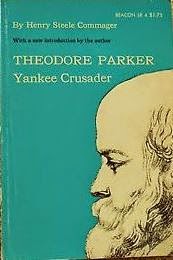
Theodore Parker: Yankee Crusader - Henry Steele Commager
The generation of Unitarian ministers and intellectuals who inhabited New England and the eastern United States during the antebellum 19th century did more to set the tone for the careful thought of American Unitarianism than any other generation or group of thinkers. Some of the more familiar names of the American Renaissance - names like Emerson and Thoreau (arguably) - or the less famous, but influential nonetheless - Channing, Howell, or Parker - found their intellectual home-ground not only in the liberal, reason-oriented faith of Unitarianism, but in each other. While Ralph Waldo Emerson was the spiritual - almost other-worldly - figurehead of this free-thinking movement, none brought so catholic a series of interests, such a broad base in learning, as Theodore Parker. If Emerson was the renowned and removed philosopher, Parker translated all his learning into a religion of the social, and brought the energy of his faith squarely to Earth.
Most famous for his work opposing slavery, Parker believed that faith and spirituality must be embodied. Perhaps it was little surprise that this man who spent so much of his formative days at labor, working until his hands were rough-hewn and callous, saw the practicable side of religion as his faith's true calling. Not only would Parker denounce slavery from the pulpit, he personally helped to move escaped slaves along the Underground Railroad, north to Canada. Standing against slavery, Parker would cajole, beseech, and even threaten men who disagreed with his theology of freedom - both privately and publicly. No peacenik was he: Parker's faith gave him the conviction that some evils must be opposed, first by reason and intellect, but if need be, by force.
It was remarked of Thomas Henry Huxley that he was "Darwin's Bulldog:" a tireless advocate for the theory of evolution while Darwin remained in retreat at Down House. We might similarly cast Parker as Emerson's, or Unitarianism's Bulldog - crusading for the right of reason and consciousness to govern men's social and spiritual lives. It might be fairly leveled at contemporary Unitarians that they are too intellectual and theoretic, too removed from the everyday articulations and actions of the spirit. Perhaps modern-day Unitarianism has inherited too much of Emerson's mind and not enough of Parker's energy.
Most famous for his work opposing slavery, Parker believed that faith and spirituality must be embodied. Perhaps it was little surprise that this man who spent so much of his formative days at labor, working until his hands were rough-hewn and callous, saw the practicable side of religion as his faith's true calling. Not only would Parker denounce slavery from the pulpit, he personally helped to move escaped slaves along the Underground Railroad, north to Canada. Standing against slavery, Parker would cajole, beseech, and even threaten men who disagreed with his theology of freedom - both privately and publicly. No peacenik was he: Parker's faith gave him the conviction that some evils must be opposed, first by reason and intellect, but if need be, by force.
It was remarked of Thomas Henry Huxley that he was "Darwin's Bulldog:" a tireless advocate for the theory of evolution while Darwin remained in retreat at Down House. We might similarly cast Parker as Emerson's, or Unitarianism's Bulldog - crusading for the right of reason and consciousness to govern men's social and spiritual lives. It might be fairly leveled at contemporary Unitarians that they are too intellectual and theoretic, too removed from the everyday articulations and actions of the spirit. Perhaps modern-day Unitarianism has inherited too much of Emerson's mind and not enough of Parker's energy.
Thursday, June 26, 2014
The Clouds - Aristophanes
On trial before his fellow citizens, Socrates asserted that rather than simply answer the set of accusations placed before the court, he must respond to an assault from an older set of accusations. In addition to the official charges, Socrates believed that many of his judges would have been prejudiced against him from claims long part of the Athenian social climate. So ingrained were these older aspersions that Socrates believed they were possibly more dangerous than the official charges. These first set of accusations cast Socrates as a kind-of intellectual charlatan, divorced from the true concerns of society; always engaged in the duplicitous act of making the weaker argument the stronger and misleading his pupils. At a time of great upheaval and uncertainty in Athenian society, Socrates was seen to be a social revolutionary, turning accepted truths on their heads and urging Athenians to break with tradition and dramatically reorient their lives.Though we cannot be sure from whence such accusations initially sprang, there is a general scholarly agreement that these 'older accusations' were given a full-throated treatment by the comic playwright, Aristophanes. In The Clouds, most likely performed around 423 bce, Aristophanes portrays Socrates as an irreligious, some might say atheistic, teacher who instructs young men to disregard their parents, break with tradition, and disassociate themselves from their community. At a time when Athens must have keenly felt the world to be in dramatic upheaval, along came Socrates and the sophists, instructing young people in strange new doctrines and seeming to threaten the very foundations of all that Athens was defending in the great Peloponnesian War. It was hardly a comfortable time to be an Athenian.
While the outlandish Socrates of The Clouds must have been appreciated as a characterization, the context which gave rise to such a portrayal surely lent the play a note of relevance and reality. Here we see Socrates aloft, investigating all the things of the air and seemingly disconnected from earthly concerns. Yet rather than being a harmless and isolated intellectual, this Socrates has opened a school, what Aristophanes called the "Thinkery" or "Thinketeria." Instructing students, Socrates and the other resident sophists turn the gaze of the young towards all areas of knowledge and cleverness, except those which the typical 5th century Athenian would have prized. As the play reaches its finale we see that what is really at issue here are the concerns about how respect for the city and its important traditions will be balanced against the uncertainty of a changing world. Aristophanes' Socrates is engaged in nothing less than the creation of a new Athens.
At this remove we do well to remember that the Greeks had different conceptions of the proper life than our own. To be removed and disconnected from society, to willingly choose a life of isolation from one's fellow citizens, would have been barbaric; borderline unthinkable to many Greeks. When Aristotle wrote that man is by his nature the political animal, what he is saying in context is that man was meant to inhabit the polis. The socio-political sphere was the very foundation of the truly human life. This belief rendered the instruction of the young a concern of great consequence. If Socrates was truly engaged in corrupting his students, and turning them away from so much that was central to Athenian life, then he threatened not only the well-being of his pupils, but the very threads which bound together society: its citizens. To what extent Aristophanes' play was taken entirely seriously, we cannot know. However, with every brick that constructed an edifice of Socrates the revolutionary figure, so much higher was the wall of opinion opposing him. Aristophanes' work was to be remembered for the claims it made against Socrates. Claims that would, in 399 bce, help lead Socrates to his doom.
Monday, June 23, 2014
Socrates on Trial - Thomas Brickhouse and Nicholas Smith
For as many years as have elapsed since the trial of Socrates in Athens (399 bce), likely even more perspectives on the messages and the vagaries, the ins and the outs, of that most famous confrontation have been forwarded. First, and most famously, was Plato, followed thereafter by Xenophon (the first commentator we know of who was not actually present). It is chiefly the oldest of accounts, Plato's, which resounds through the ages as the definitive text coloring our impressions of the father of political philosophy - we might say philosophy itself. Plato's account has fathered great debates ever since. What did Socrates really mean on that fateful day? What is the extent of Platonic revision? More so than any of Plato's other writings the Apology and the Crito are believed to bear the unmistakable stamp of the living Socrates. If, at our distant remove, we can uncover what Socrates thought and cared for, these two 'dialogues' will be our best hope. Yet, as is often the case, layers of scholarship have served to obscure more than clarify; generations have had their own Socrates and extracting any grain of truth across the ages will be a contested task. Such can be both the great curse, and the surpassing blessing, of the humanities.
To this vast bibliography Brickhouse and Smith add their perspective. Of central importance to the debate surrounding Socrates' life, and death, is the extent to which we believe the philosopher provided an honest defense of himself before his Athenian judges. Brickhouse and Smith provide a thorough and nuanced analysis which concludes that, as much as he deemed possible, Socrates sought to give a compelling and truthful defense of his life and actions. No willing martyr to latter-day philosophic interests, Socrates was earnestly trying to escape his last earthly judgment. While holding true to his belief that the virtuous life is our primary concern, Socrates refutes the claims of his accusers and attempts to persuade his judges that, not only would conviction be a miscarriage of justice, but that Athens herself would suffer from his departure.
The honesty of Socrates' attempt at a defense crucially informs how we interpret the philosophical and moral entreaties of Plato's Apology. If, as some commentators have written, Socrates is a haughty and condescending anti-democrat, then his speeches are rife with arrogant intellectualism - as though some delusional, authoritarian father-figure were addressing the unwashed masses from on high. It is difficult to shake the notion that Socrates, and Plato, have been the recipients of a bad rap during the global democratic movement of recent history. In contrast, if we adopt Brickhouse and Smith's interpretation, Socrates strikes us as an incredibly straight-forward, plain-spoken, and earnest advocate of our better angels. A sort-of Athenian moral reformer. Though he may seem obstinate, not to mention a trifle tone-deaf, in refusing to compromise his principles, does he not embody what so many of us in free society claim to prize most highly in the individual? If we agree that each person must be the driving force behind his or her own destiny then surely we can similarly agree that each should embody the Socratic creed prizing the examined life.
Readers of Plato who picture Socrates as an arrogant condescender in the Apology must answer for the Crito in which Socrates speaks to civic duty and the good of the social sphere. Viewed in contrast to one another, these two express the necessary tension of the citizen, that legal code and moral right may come into conflict. Socrates' life and death suggest that we cannot simply retreat to the easy moralist position whereby the individual has the right to govern himself or herself irrespective of society. Rather, being a moral person may require a certain disregard for the civic code, but this does not render such a code unjust. Being a good citizen demands adherence to the existing social contract. Living a virtuous life requires carrying this tension of personal morality and legal obligation. Conflict between the two does not imply that the law is simply deficient. For Socrates, a truly virtuous life meant living, and dying, with this paradox. To abstract the demands of the Apology from the obligation of the Crito is to either build grand facades of labyrinthine textual interpretation, or to label Plato a fool. Perhaps it is time for a Platonic, and Socratic, revival.
To this vast bibliography Brickhouse and Smith add their perspective. Of central importance to the debate surrounding Socrates' life, and death, is the extent to which we believe the philosopher provided an honest defense of himself before his Athenian judges. Brickhouse and Smith provide a thorough and nuanced analysis which concludes that, as much as he deemed possible, Socrates sought to give a compelling and truthful defense of his life and actions. No willing martyr to latter-day philosophic interests, Socrates was earnestly trying to escape his last earthly judgment. While holding true to his belief that the virtuous life is our primary concern, Socrates refutes the claims of his accusers and attempts to persuade his judges that, not only would conviction be a miscarriage of justice, but that Athens herself would suffer from his departure.
The honesty of Socrates' attempt at a defense crucially informs how we interpret the philosophical and moral entreaties of Plato's Apology. If, as some commentators have written, Socrates is a haughty and condescending anti-democrat, then his speeches are rife with arrogant intellectualism - as though some delusional, authoritarian father-figure were addressing the unwashed masses from on high. It is difficult to shake the notion that Socrates, and Plato, have been the recipients of a bad rap during the global democratic movement of recent history. In contrast, if we adopt Brickhouse and Smith's interpretation, Socrates strikes us as an incredibly straight-forward, plain-spoken, and earnest advocate of our better angels. A sort-of Athenian moral reformer. Though he may seem obstinate, not to mention a trifle tone-deaf, in refusing to compromise his principles, does he not embody what so many of us in free society claim to prize most highly in the individual? If we agree that each person must be the driving force behind his or her own destiny then surely we can similarly agree that each should embody the Socratic creed prizing the examined life.
Readers of Plato who picture Socrates as an arrogant condescender in the Apology must answer for the Crito in which Socrates speaks to civic duty and the good of the social sphere. Viewed in contrast to one another, these two express the necessary tension of the citizen, that legal code and moral right may come into conflict. Socrates' life and death suggest that we cannot simply retreat to the easy moralist position whereby the individual has the right to govern himself or herself irrespective of society. Rather, being a moral person may require a certain disregard for the civic code, but this does not render such a code unjust. Being a good citizen demands adherence to the existing social contract. Living a virtuous life requires carrying this tension of personal morality and legal obligation. Conflict between the two does not imply that the law is simply deficient. For Socrates, a truly virtuous life meant living, and dying, with this paradox. To abstract the demands of the Apology from the obligation of the Crito is to either build grand facades of labyrinthine textual interpretation, or to label Plato a fool. Perhaps it is time for a Platonic, and Socratic, revival.
Subscribe to:
Posts (Atom)