Monday, April 11, 2016

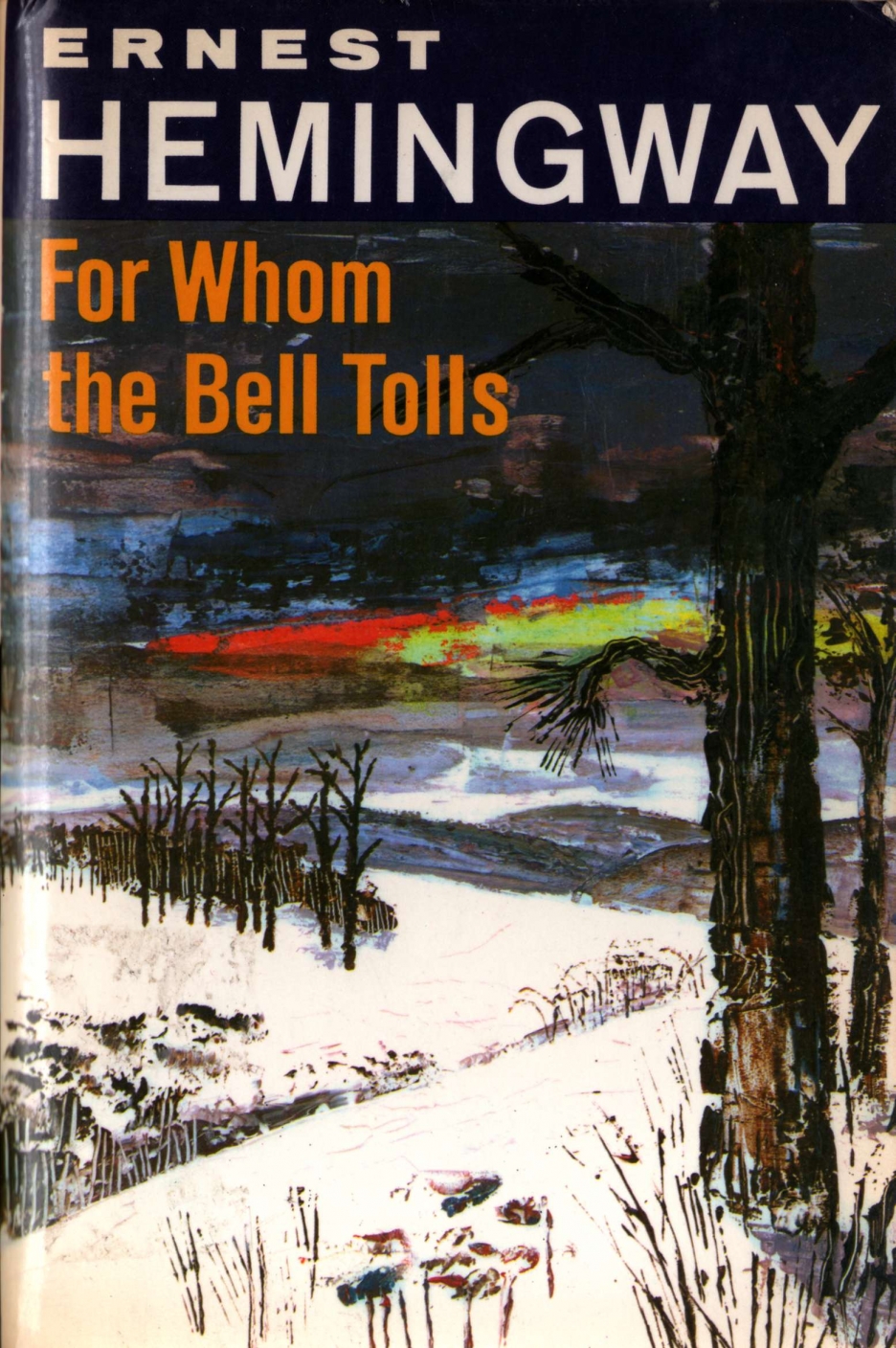
For Whom the Bell Tolls - Ernest Hemingway

"The world is a fine place and worth fighting for..."

Hemingway's world consists of people and relationships. Of men: their origins tethering them to cultures of pride, discouragement, complications, and characters. Their lives are both lived within themselves as members of, though also slightly transcendent of, their circumstance. Each is of a time and place - though never fully constrained by nor defined by it. National character, culture, circumstance, only carry one so far. We are all slightly surprising to ourselves and others. Yet the wheel of the self spins and we are brought circling back to those repeating aspects by which the self is known to itself and others. In this way the individual is simultaneously bound and free - both predictable and utterly perplexing. Unique entity.

So too is human exchange anchored and uncertain. Our means and modes of interaction ring familiar notes; yet each tune stands apart. The structures of relationships - between friends, or fathers and sons, mothers and daughters, superior and subordinate, or between lovers - provide certain norms and folkways, certain ways of being in exchange. Yet each instance is its own. The tension of sameness and novelty pervades relations.

Life and the world can thus be viewed through a microcosm. But each microcosm is necessarily incomplete. A map with a perfect fidelity to reality is nothing less than the world entire. Three days may be sufficient to know the world. In this, our own microcosm, sameness and novelty contest. We are grounded and chained and set free.

Saturday, February 6, 2016

Team of Rivals - Doris Kearns Goodwin

What are the factors which make a person? The question contains two parts. First is character: how is it that each of us becomes what we are? Second is the manner in which each of us are known: how we are understood, conceived to be by the world around us. In this latter account we are of our time, and, to the extent that we are remembered and reconceived in the minds of others, of other times as well. In this second estimation each is fully of the world. Of the first, that of character, similarly each seems shaped by their environment. Yet, the individual is somewhat transcendent of it - unique in a way that we have not learned to account for. Such transcendence is manifest in the somewhat surprising actions of people. Sometimes an individual's transcendence - their personality - moves beyond their small circle of associates to the wider world. Yet, to be thrust forward to the precipice of eternity requires the even less understood vagaries of the world and the forces that call certain generations to grapple with the problems of the ages. Then the transcendence of the individual may stand athwart opposing forces and forever leave its stamp. Abraham Lincoln was, by any measure, among the greatest of American personages. That he has become so is surely due to his character and the environments that shaped him, but it was also due to that great societal conflict, the Civil War, that Lincoln was able to forcefully leave his stamp on history.

Doris Kearns Goodwin's work traces the rise of Lincoln and his adversaries for the 1860 Republican Presidential Nomination. As an exercise in comparative biography Kearns Goodwin strives to show us how Lincoln and his rivals were men of their time; forged by riding the circuit, public service, negotiating positions on America's "peculiar institution," and their lust for power. In each man's rise we see the tenuous years of Antebellum America and how each negotiated their lives within it. Kearns Goodwin is masterful in drawing portraits of character; we feel that we have seen the essence of Lincoln, Seward, and Chase. Yet the work is somewhat uneven in balancing the genius of Lincoln's politics with the personal and social lives of he and his rivals. We are often left under-informed about the contexts of the political difficulties that Lincoln so tactfully threaded. While the force of his personality, in particular his capacity for forgiveness and magnanimity seemed to know no bounds, his politics was also eminently practical. Yet, the full situating and the subsequent implications of this practicality could stand a more thorough treatment.

More than anything this is a work of character exposition. That Lincoln's character was demanded by the historical moment is made manifest and how this was forged is accounted for carefully and brilliantly. As an historical analysis of politics the picture is less clear and forceful. Perhaps this is the legacy of Lincoln: it is the man who shines out from history.


Sunday, January 17, 2016

A History of South Africa: Social and Economic - CW De Kiewiet

Land, climate, and conflicting peoples: these have been the foundations of South African social and economic life. CW De Kiewiet's history, first published in 1941, recounts attempted, imposed, but ultimately unattainable separations within South Africa. Early colonization sought to make the Cape a way-station for trade between Europe and Asia - seeking to abstract this outpost of economy from its environs. Later Dutch settlers wished to remain at a distance from Cape colonial administrative strictures. As the Boers headed to the hinterlands they wished to found their own society, free of natives and imperial requirements. The Transvaal and the Orange Free State wanted independence; liberty to govern themselves and the natives. The Boers did not, however, wish to shake themselves loose of the land, but to inhabit it and dispose of it as they saw fit. Had the lands which were later to be united as South Africa remained so resource-poor the Boers may have gotten their wish.

Whether for good or for ill gold was discovered on the Witwatersrand in surpassing abundance in 1886. This was not California gold - the kind available to the solitary miner with his pan in a stream. The gold of the rand ran in deep, diffuse veins. Vast economies of scale, huge labor forces, and uncountable tons of dynamite, shovels, pickaxes, trolleys, and beams were needed to extract the gold and make it pay. In hordes they came to work the fields, both black and white. The Tshona, the Zulu, the Khoi and the Xhosa; Boers, British, Germans, Australians, and Americans. Soon these latter ones, foreign whites, the Uitlanders, outnumbered Boer citizens, but remained devoid of political rights. Who was to be responsible for these Uitlanders, and who would ensure their rights? The companies? The Cape? The republics of the Transvaal and Orange Free State? The Boers were adamantly defensive of their culture and livelihoods - to grant equality to the Uitlanders would be to lose their identity. There was no question of the natives.

Witwatersrand would prove to be the richest gold field in the world, bringing the world to South Africa. Economy brought together all of that which had been previously kept asunder. With the invasion of the world new environments and new communities were built. The contact of men with one another, between people and the soil, and the slow collision of different communities in regards to the land and their neighbors composes the early history of South Africa. The story of one comprises the story of many.

Sunday, December 13, 2015

March Up Country (Anabasis) - Xenophon

Though for their part victorious at Cunaxa, the death of Cyrus left the Ten Thousand Hellenes deep in Persia, with few prospects. Without supplies and soon-to-be leaderless, the Hellenic mercenaries would turn to Xenophon, something of an aide-de-camp who was along primarily for the adventure.

Anabasis ("going up") is the story of how the Ten Thousand Hellenes survived and made it ever-closer to Greece, through hostile Persian territory. Xenophon's prose is straight-forward, even somewhat terse. Though he can clearly deliver a stirring oration with the best, when it comes to relating an army's actions or the account of a march, Xenophon is all economy. One gets the sense that, while the settings and challenges are to be accounted for, what matters most is the right way to respond. Settings, particularities: these change. Right thinking and action transcend.

Xenophon makes a different kind of protagonist: he answers to what the world gives him. He is a marked departure from the mythological basileus; a very classical Greek hero. Achilles was all rage, destruction, petulance, and mayhem. Odysseus was the man of many talents, the skilled and learned, crafty and able. Xenophon is the honorable, the right-thinking, the philosopher-soldier. He provides a new kind of Greek ideal.

Xenophon's influence redounds. It is said that Alexander the Great carried the Anabasis as a field manual. Christiaan de Wet had a copy always at hand as he rode and hid in the veld during the Boer War. Xenophon espouses a particular philosophy of leadership: a transparency, a straight-forward practicality, a soldier's ethic. One wonders what it would mean to adopt it beyond the campaign. Maybe there is nothing beyond it. Much as the Ten Thousand seek a way home, we too wish to lay our burden down. Maybe there is no rest.

"thálatta, thálatta"

Friday, December 11, 2015

Guns, Race, and Power in Colonial South Africa - William Kelleher Storey

Firearms were not simply tools or weapons which colonials and natives picked up and put down. They were symbols of power, source of legal wranglings, and the means through which power and independence were exercised. Here tools and discourse were interwoven; each shaping the other.

Storey looks at the role of firearms throughout the colonial period in South Africa (ending with the Boer War). Firearms, he finds, were diversely manifest through time. They developed from wildly inaccurate muzzle-loaders to more precise breech-loaders. On the frontier of the veld they were seen to serve one function, on farms another, near urban areas still another. British bureaucrats and law-makers, both in the metropole and within the colonial center (Cape Town, Port Elizabeth, D'urbanville) tried to control access to firearms, as a means of controlling the social sphere. Of course, firearms could also be means to challenge power. Therein lay much of the foundation for wrangling over access to firearms.

As a lens through which to view the social sphere firearms allow us to see particular things well - access to political power and speech, changing aspects of self-sufficiency and freedom - yet they can also be manifestations of these things. The question of which comes first tends to ground-out in circularity - each led to the other through a dynamic relationship. Do we find this a satisfying category of historical explanation? It is certainly a common one. This seems indicative of a broader ontology within historical scholarship.

Thursday, October 29, 2015

The Boer War - Thomas Pakenham

The commitment, even quixotic commitment, of the Boers. The irrepressible weight of the British military. In its time the Boer War seemed the defining moment, not just for a young and divided South Africa, but for British imperial prospects. Yet, in retrospect, twentieth century events would diminish the conflict's import. Global geopolitical winds and contestations rendered it little more than, as TE Lawrence might have said, "a side-show of a side-show." Afterwards the British interest would recede. The Boers of the Free State and the Transvaal would have their sovereignty. This was the last imperial gasp. The British gained their victory. It, like the Union of South Africa, would come at a terrible cost.

Thomas Pakenham's The Boer War is the history of the twentieth century's first war. In this remote corner of Africa, the set-piece battle of the imperial period gave way to methods of the guerrilla, to the tactics of the trench. The British shipped-off to Natal, the Transvaal, the Cape Colony, and the Free State, unprepared for what they would encounter. It was to be a "walk-over." "Christmas in Pretoria," they said. Yet, out on the veld, British troops were ill-prepared for the costs the Boers would hazard. Only by subjugating women and children, and, yes, even the land, could the British steamroller achieve victory.

Pakenham can rightly be criticized for his marginalization of the native population. Too often armies and commandos march and slip across the landscape; invisible are the inhabitants whose very lives and livelihoods hung in the balance of the conflict. Yet, this oversight is all the more apparent because the fighting feels so fresh, so present. The Boers and the British ushered in a new age of destruction, to be fully realized at Verdun and the Somme.

Though the British would prove victorious, the Boer War marked the end of the colonial period in South Africa. The peace brokered set the stage for the country's independence, a few years later. Pakenham's story, sometimes too often of military might and back-room politics, recounts the first hints that a global order was in retreat. Similarly, this account can be read as a somewhat bygone mode of history. Nevertheless, the humanity and savagery of the Boers and the British, and the lessons which Pakenham draws from it, resonate still.

Thursday, October 22, 2015

Zen and the Art of Motorcycle Maintenance - Robert Pirsig

Pirsig's emphasis on the relationship between thought context and care binds this work. What we think, and how these are manifest in what is said and done, indicates a type of psychic position in relation to our caring. Care is an investment in the arena of concern; an interested-ness, both in it, and the self's relation to it. Pirsig's concern is the source of the seeming alienation between the modern self, and our thoughts and actions regarding the world and each other. The prevailing thought context is one in which the distance between care and thought, as well as the distance between care and action, has been deemed unimportant. Rationality, in conception and exercise, looks at the distancing of care from thought and action, and finds no grounds to suggest that they ought to be unified. This, Pirsig argues, is a short-coming of rationality, a short-coming which demands that rationality be expanded.

Prisig's answer to the modern feeling of alienation requires that we turn that feeling upon itself; in essence both using this pre-intellectual awareness as an entry point and holding it up for interrogation. Alienation is born from the awareness that our lived context - the social world we inhabit - is somehow unsatisfactory. Yet, our thought context does not readily provide us with the tools to interrogate and voice such dissatisfaction. This was the germ for the counter-cultural movement, for consciousness-expanding practices and narcotics, for the draw of charismatic religions and religious figures; each taps into a subtle but pervasive discontent with acceptable expressions of how our minds relate to the social world we inhabit. Like a muscle, a particular perspective on the world is strengthened or weakened by use. If we do not ignore the pre-intellectual awareness of discontent, if it serves as the foundation to build modes of thought unrecognized in narrow rationality, then people might learn to see differently.

But the sense of alienation cannot simply be overcome by the imposition of a new thought program. The psychic relationship between care and thought context must recognize that care is related to thought. Expressed in the world, care is the flip-side of Pirsig's Quality. Care in thought and action is both reinforced by Quality and helps to generate Quality in the world. The relationship between thought context and care is, for Pirsig, primarily defined in regards to its treatment of Quality - as it exists within the individual, within the world, and within the relationship between the two. Right thought comes from right attitudes Its having the right attitudes that is hard.

"Don't worry... Keep going!"