Sunday, August 26, 2012

The Years of Lyndon Johnson: The Passage of Power - Robert Caro

Robert Caro's fourth installment of his life's work documenting the years of Lyndon Johnson, The Passage of Power, details how LBJ, unable to overcome some of his most deeply-rooted demons, was unable to grab for the presidency when it might have been his. Eventually receiving second-billing on the Kennedy ticket, Johnson was seemingly ushered off the stage of history, relegated to a ceremonial bystander while "the best and the brightest" governed America. But, as of course we now know, this was not to be Lyndon Johnson's political obituary. With the crack of an assassins bullet that fateful morning in Dallas, the power Johnson had so long striven for, "by God, I'll be President someday," was suddenly thrust upon him. What Johnson did then, was, in Caro's detailed recounting, nothing short of unequaled in the history of the American republic. In a moment of supreme national agony, Johnson not only ably and with great command grasped the reins of power, but simultaneously assured the smooth transition of government, engineered the passage of monumental domestic legislation, and all but assured his re-election in a Presidential contest less than a year hence. While Johnson's three years as Vice-President may have been pure personal torture, his first seven weeks in office redound as perhaps his greatest personal triumph.

Caro has painstakingly researched the life and years of Lyndon Johnson to such an extent that we cannot help but wonder if another biography of the man and his times will ever be necessary. Throughout the four (soon-to-be five) works he has maintained a coherency of narrative allowing the reader (at least those willing to venture through 3,000-plus pages already published) to connect Johnson's strengths as a leader and man of vision, with the deeply rooted convictions bred in him from the his youth in the Texas Hill Country. What is more awe-inspiring, and perhaps more tenuous, is how Caro allows his audience to see, and to feel, LBJ's monumental insecurities, which, though he may have been able to overcome them in his first weeks as President, cannot help but loom as a grim specter over this volume. For if Lyndon B. Johnson's first days as President redound to his credit, and can be seen as a momentous capstone to a life dedicated to the pursuit of political power, then the reader cannot help but sense the extent to which the next (and final) volume, due out in two or three years, will fully detail how Johnson's weaknesses (as well as his strengths), of character, of upbringing, will conspire with events beyond his control to derail his long-held ambitions. In the end, Johnson's story cannot but be one of tragedy, pure and simple.

Tragedy requires that, for those with eyes to see, the writing is on the wall: it is only with an inevitable sense of impending doom that any tragedy is deserving of the title. We can begin to see here that the seeds for Johnson's destruction were sown in his earliest days. From The Path to Power up through this latest installment, Johnson's character has at once been his greatest strength, and his own worst enemy. What has been inescapable throughout has been LBJ's inability to moderate himself for any extended stretch of time; his seeming unwillingness to recognize that he can be his own worst enemy. When Caro describes Johnson's first weeks as President as so successful despite the man's shortcomings, the reader knows exactly what is meant. Now it is up to Caro, long after the death of this towering figure, to truly complete his story. In his research and writings Caro's work has become the definitive voice on the Years of Lyndon Johnson, and we can now begin to fully understand that those years cannot adequately be measured, our assessment of Johnson as man and as a political, as well as historical figure, not fully understood, until Caro has written his final line. For now, the last bit of Johnson's legacy still remains undisclosed and untold. Only Caro can achieve such an ending. It is the historian who will have the final word.
We wait with baited breath.

Sunday, August 19, 2012

On the Modern Cult of the Factish Gods - Bruno Latour

Still engaged in uncovering what he calls the anthropology of the Moderns, Bruno Latour interrogates the differences, and strange similarities between science and religion. Resulting from his investigation is the conclusion that we, us Moderns, have got the relationship between science and religion all wrong. While we cast religion as being primarily concerned with some illusory world out-there, inhabiting some sort of alternative plain, Latour seeks to convince us that religion is first and foremost concerned with the here and the now, with our internal relationship to the world as we move about it. Conversely, while science is held to be concerned primarily with what is evident and immutable all around us, Latour demonstrates that it is only by covering vast spaces and leaping between different manners of reference that we can say with some certainty of faith that scientific endeavors allow people to speak meaningfully about the world.

Central to Latour's arguments is the revocation of the subjective/objective world view. Once we are able to disprove that the world simply exists "out-there" while we ourselves are trapped "in-here" (as Latour ably proves), we are led to re-imagine what sort of relationship our ways of knowing have to the manner in which we live, and, in how we conceive of the relationships between our epistemologies. Latour argues that trying to compare the differing knowledges of religious insight and scientific truth is misguided, for they are dealing with fundamentally different realities. Once we understand that the two spheres are not engaged in speaking about the same aspects of experience, we can reconcile their shared insights rather than contrasting two approaches that were not meant to contest in the first place.

Sunday, August 12, 2012

Hirohito and the Making of Modern Japan - Herbert P. Bix

If we are to believe Herbert Bix, history has largely cast Japanese Emperor Hirohito as a relatively uninfluential bystander of Japan's involvement in the Manchuria and World War II. If we are to further believe Bix then a more in-depth look at what records are available reveals a picture of the Emperor as not only integral to Japan's war effort, but as systematically protected by his advisers in the aftermath of Japan's capitulation. With these assertions firmly in place - and to be  fully supported by what appears to be exhaustive research - Bix examines the life of the Showa emperor, particularly his political life leading up to the end of US occupation in Japan - in great depth. The result is a biography of one of the twentieth century's most misunderstood, shadowed and, eventually impactful men.

Seemingly miscast for the role of god-king into which he was born, the Showa Emperor, and grandson of the eminent Meiji, would forever remain uncomfortable asserting his total authority and even cowardly in accepting responsibility for Japan's armed forces. With a naturally retiring personality Hirohito would hold meetings of his advisers in which, after long hours, he would have said nothing at all. Leaving it to his lieutenants to deliver news, good or bad, to Japan's decision-makers, we are led to believe that Hirohito largely allowed himself to be led by wherever his strongest advisers wanted him to go. How then to square that with Bix's claim that, more so than anyone, it is upon Hirohito's shoulders that responsibility ought rest for the course of Japan in the 1930s and early 40s? While publicly trying to paint the Emperor's role as that of a British-style constitutional monarch, the truth is that Emperor's power was potentially, and at times in actuality, much more absolute. Hirohito had utmost control over Japan's armed forces and willingly allowed his generals and soldiers to perpetrate crimes that he viewed as unacceptable, but was simultaneously unwilling to stop. It was potentially within the Emperor's power to punish perpetrators and enact Japanese policies, which he was often made aware of long in advance, that could have altered the course of events, in relation to crimes against humanity and failures in persecution of the war effort. Yet, time and again, Hirohito refused to live up to his responsibility. When defeat came to Japan at the end of World War II, he was consumed with ensuring that he would remain Emperor of his country and free of any official suspicion of war crimes. As such the Emperor allowed, and sometimes encouraged the misrepresentation of war-time blame that was placed upon his generals and advisers. With the help of General MacArthur, Hirohito ensured the role of himself as necessary figurehead of a Japan in transition to post-war state. Though he was rendered largely politically impotent by the new Japanese constitution, the Showa Emperor was allowed to retain his title, his baubles and his freedom.

While Bix's biography sometimes lingers over the details of Japanese political machinations, while ignoring the larger impacts on the country - thus painting a picture of a political culture totally isolated from the people it governed - the inner workings of the Japanese system and the man whom they revolved around are given great detail and fleshed out with a character believable for his flawed nature. It is too simplistic to call the Emperor a coward, rather, Bix paints a picture of a man thrust into a role he at once felt duty-bound to succeed in, and was cursed to carry his entire life.

Saturday, August 11, 2012

Ghost Soldiers - Hampton Sides

During the closing months of World War II it was apparent that America was winning the war in the Pacific against Japan. With American ground and sea forces advancing towards the mainland the Imperial Army was in full retreat, which meant the abandonment of bases and the pressing concern of what to do with allied prisoners of war (POWs). Rumors were circulating through official and unofficial channels of massacres occurring across the islands - POWs being executed en masse by all manners of fire, poison, shootings and even being run down by tanks. As forces advanced the worry was ever-present that the Japanese would leave no evidence of the maltreatment of prisoners throughout the war. Hampton Sides recounts the story of one rescue mission, sent to retrieve some of the last surviving members of the Bataan Death March; the last of the last left in a camp soon to be evacuated by the Japanese.

Sides endeavors to tell two stories: one of an elite group of American Army Rangers marching through the jungle night, of men primed and ready to go for a job which would require the help of guerillas on the ground and villagers along the way to ensure their secrecy. This thirty mile march would rely heavily on the element of surprise to catch the Japanese unaware so they would not slaughter POWs as the Rangers arrived. Second are the grim stories of those same POWs and how they managed to, some of them, survive for years in the camps. Fighting tropical diseases and malnutrition, constant worry over an end that might come at any time, and feeling totally abandoned by their country - left to the whims of their captors - these POWs would see and experience some of the worst crimes performed by men on each other.

Though this is ostensibly a story about patriotism and heroism, it is also a story about humility and the extent to which war can pit man against man and the extent of maltreatment between captors and captives. Sides admirably refuses to simply cast the Japanese as villains and the Americans as infallible heroes. War seems to bring out both the best and the worst in us all; Sides explores both aspects unblinkingly and reveals both the amazing strength and haunting demons of how we come together and are torn apart.

Wednesday, August 1, 2012

Zen Culture - Thomas Hoover

Beginning with the premise that the history of unified Japan is inseparable from that of the development of different aspects of the religion and ethos of Zen, Thomas Hoover traces the development of the country. Beginning with the first unification of government at Nara, through the Heian period and into the shogunate,Edo and modern period, Hoover is able to lucidly explain how these sociopolitical developments influenced and were part and parcel of Japan's Shinto/Buddhist religion/culture. While it may seem overly-simplistic to trace the development of any society through aspects of interior design, tea ceremonies, haiku poetry and Noh theatre, Hoover's Zen Culture  is a wonderful introduction to Japanese history and thought.

For occidental travelers Japan can often feel like a land set apart. While much seems familiar, so many aspects of culture have a certain twist that strikes the viewer as somehow fundamentally different, even to the pith of experience. Hoover gives the sense a background for anyone interested in beginning to understand both historical and modern Japan. Much of the ethos of zen is predicated upon training the mind to act clearly and lucidly: witness great masters of painting and haiku poetry, at study for years so that, when the time comes to create a masterpiece, their brushes and pens can flow thoughtlessly and fluidly, expressing deep truths about reality. For zen practitioners the undifferentiated aesthetic continuum of reality (a phrase cribbed from FSC Northrup) is the very fabric of existence. Not only are aesthetics of primary importance in zen, they are representative of everything. A rock garden is not only a backyard place for meditation, its -scape can be meant to convey subtle truths about the universe entire, and our relationship to it.

Hoover has accomplished something quite impressive in such a short work: he has written a cogent, and relatively nuanced history of Japan and the development of zen culture. The work should serve as a good base to continue to explore different understandings of a culture providing a different take of the onrush of history.

Monday, July 30, 2012

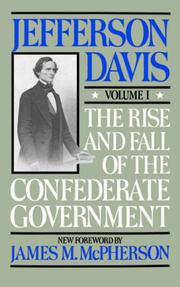
The Rise and Fall of the Confederate Government, Vol. 1 - Jefferson Davis

Written after the close of the Civil War, and after Jefferson Davis had long been relegated to a life away from the public arena, The Rise and Fall the Confederate Government reads as a defense of the right of the southern states to secede from a country that had failed to live up to the promises of the constitution. For Davis, the crux of the issue surrounded to what extent the federal government did or did not secure and protect the rights of the various states of the union, and where the sovereignty of the people was vested.

Davis reaches back to the framers of the constitution to discuss the varying interpretations of states' rights. Not surprisingly he claims that the spirit of southern secession was more in-line with the intent of the framers when they endeavored to bring the various states together under the banner of one larger government. While history remembers the perspective of the winners, Davis counters popular retellings of the Civil War by casting northern aggression as disruptive of the desires of the south, writ large, to peacefully dissolve its part in the union. By claiming that the United States was first and foremost a compact of sovereign states, which had come together under the guise of the common welfare, Davis casts the argument as the rights of the people against a tyranny of Union (northern) powers.

Though Davis continues to belabor his central argument, the work moves along to describe secession and the opening of the Civil War. Though Davis' work sometimes gets bogged down in the internal machinations of politics and bureaucracy it is undeniably of interest to any student of American history. Where the work struggles is in Davis' defense of his own actions and too much focus on the nuts-and-bolts military details (it was known at the time that Davis would have preferred a generalship in the confederate army to the presidency). Though far from a masterpiece, Davis' work allows the reader to explore many aspects of how the confederacy thought of itself, and how it imagined the direction of the United States.

Monday, June 18, 2012

The Magnificent Ambersons - Booth Tarkington

An American born in 1850, and living a standard, certainly not excessive lifespan, of 70 years, would have seen his country transformed from a largely rural, generally agrarian society, to an industrial, urban world power. Along the way the Confederacy would rise and fall, the robber barons would exploit power vacuums to become some of the wealthiest men ever seen, the north would industrialize and come to rely on far off lands for goods and resources, and the coming of the automobile, more so than its precursor the railroad, would open up the country for the quick movement of millions. One could argue that the geography of America we see today was largely set in this period. In this cyberspace I have reviewed William Cronon's work on Chicago and how the city's development greatly influenced the rise of the American West. While Cronon's work focuses on the broader context of an evolving history, Booth Tarkington's The Magnificent Ambersons looks at the fortunes (and failings) of one family, who was to profit by America's transformation, but eventually unable to deal with the emergent world.

Tarkington's work follows the life of young Georgie Amberson. Born to the preeminent family in his small, but burgeoning American town, the young Amberson shows a distinct haughtiness and force of character unbecoming to most of the town's inhabitants. When elderly gentlemen along the road wish aloud that, someday, the headstrong young man will get his comeuppance we are left little doubt that such will be the case. Unable to adapt to the new world and new expectations put on him, Amberson's grievous sin of pride eventually lays him low. Whether we feel sorry for him, and lament the passing of a certain era, or whether his end reads as so much poetic justice, is far from clear. Truly, these complications of people and their society are a part of what makes Tarkington's novel so compelling. In the end, George Amberson believed the world ought function a certain way. His inability to reconcile his ideals with a changing reality is a message still entirely relevant.