During the closing months of World War II it was apparent that America was winning the war in the Pacific against Japan. With American ground and sea forces advancing towards the mainland the Imperial Army was in full retreat, which meant the abandonment of bases and the pressing concern of what to do with allied prisoners of war (POWs). Rumors were circulating through official and unofficial channels of massacres occurring across the islands - POWs being executed en masse by all manners of fire, poison, shootings and even being run down by tanks. As forces advanced the worry was ever-present that the Japanese would leave no evidence of the maltreatment of prisoners throughout the war. Hampton Sides recounts the story of one rescue mission, sent to retrieve some of the last surviving members of the Bataan Death March; the last of the last left in a camp soon to be evacuated by the Japanese.
Sides endeavors to tell two stories: one of an elite group of American Army Rangers marching through the jungle night, of men primed and ready to go for a job which would require the help of guerillas on the ground and villagers along the way to ensure their secrecy. This thirty mile march would rely heavily on the element of surprise to catch the Japanese unaware so they would not slaughter POWs as the Rangers arrived. Second are the grim stories of those same POWs and how they managed to, some of them, survive for years in the camps. Fighting tropical diseases and malnutrition, constant worry over an end that might come at any time, and feeling totally abandoned by their country - left to the whims of their captors - these POWs would see and experience some of the worst crimes performed by men on each other.
Though this is ostensibly a story about patriotism and heroism, it is also a story about humility and the extent to which war can pit man against man and the extent of maltreatment between captors and captives. Sides admirably refuses to simply cast the Japanese as villains and the Americans as infallible heroes. War seems to bring out both the best and the worst in us all; Sides explores both aspects unblinkingly and reveals both the amazing strength and haunting demons of how we come together and are torn apart.
Saturday, August 11, 2012
Wednesday, August 1, 2012
Zen Culture - Thomas Hoover
Beginning with the premise that the history of unified Japan is inseparable from that of the development of different aspects of the religion and ethos of Zen, Thomas Hoover traces the development of the country. Beginning with the first unification of government at Nara, through the Heian period and into the shogunate,Edo and modern period, Hoover is able to lucidly explain how these sociopolitical developments influenced and were part and parcel of Japan's Shinto/Buddhist religion/culture. While it may seem overly-simplistic to trace the development of any society through aspects of interior design, tea ceremonies, haiku poetry and Noh theatre, Hoover's Zen Culture is a wonderful introduction to Japanese history and thought.
For occidental travelers Japan can often feel like a land set apart. While much seems familiar, so many aspects of culture have a certain twist that strikes the viewer as somehow fundamentally different, even to the pith of experience. Hoover gives the sense a background for anyone interested in beginning to understand both historical and modern Japan. Much of the ethos of zen is predicated upon training the mind to act clearly and lucidly: witness great masters of painting and haiku poetry, at study for years so that, when the time comes to create a masterpiece, their brushes and pens can flow thoughtlessly and fluidly, expressing deep truths about reality. For zen practitioners the undifferentiated aesthetic continuum of reality (a phrase cribbed from FSC Northrup) is the very fabric of existence. Not only are aesthetics of primary importance in zen, they are representative of everything. A rock garden is not only a backyard place for meditation, its -scape can be meant to convey subtle truths about the universe entire, and our relationship to it.
Hoover has accomplished something quite impressive in such a short work: he has written a cogent, and relatively nuanced history of Japan and the development of zen culture. The work should serve as a good base to continue to explore different understandings of a culture providing a different take of the onrush of history.
Monday, July 30, 2012
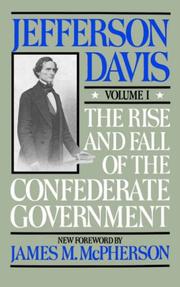
The Rise and Fall of the Confederate Government, Vol. 1 - Jefferson Davis
Written after the close of the Civil War, and after Jefferson Davis had long been relegated to a life away from the public arena, The Rise and Fall the Confederate Government reads as a defense of the right of the southern states to secede from a country that had failed to live up to the promises of the constitution. For Davis, the crux of the issue surrounded to what extent the federal government did or did not secure and protect the rights of the various states of the union, and where the sovereignty of the people was vested.
Davis reaches back to the framers of the constitution to discuss the varying interpretations of states' rights. Not surprisingly he claims that the spirit of southern secession was more in-line with the intent of the framers when they endeavored to bring the various states together under the banner of one larger government. While history remembers the perspective of the winners, Davis counters popular retellings of the Civil War by casting northern aggression as disruptive of the desires of the south, writ large, to peacefully dissolve its part in the union. By claiming that the United States was first and foremost a compact of sovereign states, which had come together under the guise of the common welfare, Davis casts the argument as the rights of the people against a tyranny of Union (northern) powers.
Though Davis continues to belabor his central argument, the work moves along to describe secession and the opening of the Civil War. Though Davis' work sometimes gets bogged down in the internal machinations of politics and bureaucracy it is undeniably of interest to any student of American history. Where the work struggles is in Davis' defense of his own actions and too much focus on the nuts-and-bolts military details (it was known at the time that Davis would have preferred a generalship in the confederate army to the presidency). Though far from a masterpiece, Davis' work allows the reader to explore many aspects of how the confederacy thought of itself, and how it imagined the direction of the United States.
Davis reaches back to the framers of the constitution to discuss the varying interpretations of states' rights. Not surprisingly he claims that the spirit of southern secession was more in-line with the intent of the framers when they endeavored to bring the various states together under the banner of one larger government. While history remembers the perspective of the winners, Davis counters popular retellings of the Civil War by casting northern aggression as disruptive of the desires of the south, writ large, to peacefully dissolve its part in the union. By claiming that the United States was first and foremost a compact of sovereign states, which had come together under the guise of the common welfare, Davis casts the argument as the rights of the people against a tyranny of Union (northern) powers.
Though Davis continues to belabor his central argument, the work moves along to describe secession and the opening of the Civil War. Though Davis' work sometimes gets bogged down in the internal machinations of politics and bureaucracy it is undeniably of interest to any student of American history. Where the work struggles is in Davis' defense of his own actions and too much focus on the nuts-and-bolts military details (it was known at the time that Davis would have preferred a generalship in the confederate army to the presidency). Though far from a masterpiece, Davis' work allows the reader to explore many aspects of how the confederacy thought of itself, and how it imagined the direction of the United States.
Monday, June 18, 2012
The Magnificent Ambersons - Booth Tarkington
An American born in 1850, and living a standard, certainly not excessive lifespan, of 70 years, would have seen his country transformed from a largely rural, generally agrarian society, to an industrial, urban world power. Along the way the Confederacy would rise and fall, the robber barons would exploit power vacuums to become some of the wealthiest men ever seen, the north would industrialize and come to rely on far off lands for goods and resources, and the coming of the automobile, more so than its precursor the railroad, would open up the country for the quick movement of millions. One could argue that the geography of America we see today was largely set in this period. In this cyberspace I have reviewed William Cronon's work on Chicago and how the city's development greatly influenced the rise of the American West. While Cronon's work focuses on the broader context of an evolving history, Booth Tarkington's The Magnificent Ambersons looks at the fortunes (and failings) of one family, who was to profit by America's transformation, but eventually unable to deal with the emergent world.
Tarkington's work follows the life of young Georgie Amberson. Born to the preeminent family in his small, but burgeoning American town, the young Amberson shows a distinct haughtiness and force of character unbecoming to most of the town's inhabitants. When elderly gentlemen along the road wish aloud that, someday, the headstrong young man will get his comeuppance we are left little doubt that such will be the case. Unable to adapt to the new world and new expectations put on him, Amberson's grievous sin of pride eventually lays him low. Whether we feel sorry for him, and lament the passing of a certain era, or whether his end reads as so much poetic justice, is far from clear. Truly, these complications of people and their society are a part of what makes Tarkington's novel so compelling. In the end, George Amberson believed the world ought function a certain way. His inability to reconcile his ideals with a changing reality is a message still entirely relevant.
Friday, June 8, 2012
Birdscapes - Jeremy Mynott
That people feel a certain connection with, or affinity for birds can be traced across different societies, throughout time, the world over. How people come to know and interact with birds is recorded in scientific studies, literature reviews, conservation organizations, and folklore (among others). Throughout there seems to be something about birds in particular that gives flight to human imagination [pun intended]. But understanding why birds play such a role in our lives remains a truism largely unexplored. To better understand the interaction between bird-life and humanity, Jeremy Mynott sets about to review a panoply of the different ways that people have come to know and think about birds. Mynott tells us that it is our interactions with birds, the constitutive process by which we come to know and think about them, that tells us the most about human interactions with the world. Far from simply offering an insight into birds, Mynott believes that a reflection on the meaning of birds to people can also provide insight into ourselves.
There are many ways to experience birds and Mynott runs through quite a gamut of them.Whether it is birdsong on a summer morning, the paintings of Audobon, religious and cultural icons, visitors to our home and garden, or rare glimpses of a wandering migrant out at sea, birds can variously perform many social roles. As avatars in religious iconography they represent the hopes of people in another world. Flying over trees and across mountains - who hasn't looked longing at the prospect of flight? Calling in the first notes of spring, or departing in the autumn for warmer climes, they can remind us of the wheel of time and the changing seasons. Crucial to all of these is not simply what birds are, but what sort of values we imbue them with; the reality we perceive is largely of our own creation. To each interaction any bird will bring certain things, but so will all people, and what we take away depends largely on how we experience the world around us. Mynott shows that there are many levels of identification and recognition between people and the world. Focusing on the different roles of birds in our minds and in the world around us lends insight to our own place and lives.
Tuesday, June 5, 2012
The Power Broker - Robert Caro
In the end, the most intriguing, and perhaps beguiling, aspect of Robert Moses was the man's sheer energy. Well into his eighties the force of the man who once called aids at all hours of the night, who would appear at the door for his limousine with an already completed stack of memos and missives before he even set out for work, remained simply over-powering. A man who attained power rarely equaled in free and open societies was, by the end of his days, reduced to a bystander on the very stages he had helped envision and realize. Yet he wouldn't slow down; refused to. Made frequently manic by his still-existent stores of energy and desire to Get Things Done as he always had, Robert Moses, the master builder of New York was to be eventually pried-away from the power he cultivated and accrued over forty-four years in the public's service.
Robert Caro's biography of this massive man is itself a massive undertaking. Seemingly the highest compliment one could give an 1162-page book is this: I wish it had been longer. The depth of research in Caro's work is so great, that the reader can almost feel the different places where information has been cut out; where Caro had to either be reined in, or reined himself in for the sake of the work's completion. With the recent publication of Caro's fourth installment in the Years of Lyndon Johnson, so much has been written about his talents that I scarcely feel the need to elaborate them here. I will limit my own plaudits to one simple assertion: he is, without question, the greatest biographer or historian I have ever read.
In this, his maiden biography, Caro delves deep into the man that was Robert Moses. The man who would build New York as we recognize it. The man who would exploit vacuums of power that other men could never dream existed, and employ that power to rule a kingdom of his own creation with an iron will. Moses was clearly a man of great brilliance, great vision and a powerful man of political and bureaucratic acumen. Yet it seems that what truly set him apart was his single-minded willingness to push and drive himself and those around him. Caro deals with the great panoply of Moses ethics and to what extent he gave a lick for the millions of people whose lives who altered irrevocably, but, whether we think of him as the master builder or simply the greedy power broker, we cannot help but marvel at all that a man of total dedication to his cause was able to achieve. Yet even with all these great monuments, what exactly Moses set out to realize remains as shadowy and complex as the man himself. Why dedicate your life to the construction of such public works? Was it for the glory of one man or for the benefit millions of people? Why push so relentlessly to ensure total control over all aspects of construction? Why jealously accrue power that cannot but insulate oneself from the world around you? In the end Caro provides numerous insights into the character and causes of Robert Moses. But we are left with unanswered questions. Questions that Caro allows to hang over Moses' machinations, triumphs, and eventual failures. These are not a shortcoming of the work - far from it. Rather, Moses leaps from the page as a fully human entity. That being human means being riven by contradiction and uncertainty as to our roles and relationships with the world around us allows for a person's character to be explored fully. Rather than provide a closing chapter, a gross simplification of this towering man's life, Caro has laid Moses and his times bare, so that, whether good or bad, he remains one for the ages.
Robert Caro's biography of this massive man is itself a massive undertaking. Seemingly the highest compliment one could give an 1162-page book is this: I wish it had been longer. The depth of research in Caro's work is so great, that the reader can almost feel the different places where information has been cut out; where Caro had to either be reined in, or reined himself in for the sake of the work's completion. With the recent publication of Caro's fourth installment in the Years of Lyndon Johnson, so much has been written about his talents that I scarcely feel the need to elaborate them here. I will limit my own plaudits to one simple assertion: he is, without question, the greatest biographer or historian I have ever read.
In this, his maiden biography, Caro delves deep into the man that was Robert Moses. The man who would build New York as we recognize it. The man who would exploit vacuums of power that other men could never dream existed, and employ that power to rule a kingdom of his own creation with an iron will. Moses was clearly a man of great brilliance, great vision and a powerful man of political and bureaucratic acumen. Yet it seems that what truly set him apart was his single-minded willingness to push and drive himself and those around him. Caro deals with the great panoply of Moses ethics and to what extent he gave a lick for the millions of people whose lives who altered irrevocably, but, whether we think of him as the master builder or simply the greedy power broker, we cannot help but marvel at all that a man of total dedication to his cause was able to achieve. Yet even with all these great monuments, what exactly Moses set out to realize remains as shadowy and complex as the man himself. Why dedicate your life to the construction of such public works? Was it for the glory of one man or for the benefit millions of people? Why push so relentlessly to ensure total control over all aspects of construction? Why jealously accrue power that cannot but insulate oneself from the world around you? In the end Caro provides numerous insights into the character and causes of Robert Moses. But we are left with unanswered questions. Questions that Caro allows to hang over Moses' machinations, triumphs, and eventual failures. These are not a shortcoming of the work - far from it. Rather, Moses leaps from the page as a fully human entity. That being human means being riven by contradiction and uncertainty as to our roles and relationships with the world around us allows for a person's character to be explored fully. Rather than provide a closing chapter, a gross simplification of this towering man's life, Caro has laid Moses and his times bare, so that, whether good or bad, he remains one for the ages.
Sunday, June 3, 2012
An Inquiry into the Good - Nishida Kitarō
Attempting to synthesize the rational approach of Western philosophy with the undifferentiated aesthetic continuum truths of the eastern Zen tradition, turn-of-the-century philosopher, and founder of the Kyoto school, Nishida Kitarō explores direct experience and what it tells us about how to live a full human life. For Nishida it is not that there are experiences because of individuals, rather, individuals are the result of experience. This seemingly innocuous inversion open the pathway to a philosophy wholly divergent from most of the western approach (certainly from such thinkers as Augustine and Descartes).
Nishida speaks of a philosophy premised upon pure experience - doing away with the a priori or forms, or other realms acting upon reality. For him reality is most satisfactorily explained by interrogating that which is actually experienced. Rather than rely on the comfortable division between subjective and objective, what is seen as perhaps the primary offspring of western rationalism, Nishida preempts such division by casting it as little more than a construction the mind places upon a just-experienced reality. As is mentioned in Pirsig (probably echoing Nishida), there is a lag between reality as we experience it in the present, and our intellectual unpacking of the world around us, which can only really deal with the past - no matter how recent our lens focuses. This time lag is, for Nishida, not an inconsequential aspect of our existence, for it is in the passage between present and future that our intellectual concepts go to work to carve up experience. It is in this passage that mind and matter become distinguishable. Rather than having the subject meet the object, the two become abstracted from pure experience; therein lies the difference. For Nishida consciousness is an activity, one in which we are inseparable from that which we study.
Nishida interrogates this unity of people and the world under the heading phenomena of consciousness. For Nishida the world is made by and in the minds of people, while people are made by the world they live in. Once a person understands that these are nothing but the same thing they are reaching towards the unity required of a person to live in accord with experience, which is itself the phenomena of consciousness. Here we can see that Nishida is not so far from the western tradition after all. It was the Oracle at Delphi who instructed Socrates only to "know thyself." Nishida agrees. For he sees reality as the good, and an understanding that reality is constantly an event that we produce means that the good is both with and around us. This is the unity of consciousness. When world and the individual are seen to be resultant of the same process of development and completion, morality and reality can bear upon one another; existence and value are fundamentally one.
Nishida speaks of a philosophy premised upon pure experience - doing away with the a priori or forms, or other realms acting upon reality. For him reality is most satisfactorily explained by interrogating that which is actually experienced. Rather than rely on the comfortable division between subjective and objective, what is seen as perhaps the primary offspring of western rationalism, Nishida preempts such division by casting it as little more than a construction the mind places upon a just-experienced reality. As is mentioned in Pirsig (probably echoing Nishida), there is a lag between reality as we experience it in the present, and our intellectual unpacking of the world around us, which can only really deal with the past - no matter how recent our lens focuses. This time lag is, for Nishida, not an inconsequential aspect of our existence, for it is in the passage between present and future that our intellectual concepts go to work to carve up experience. It is in this passage that mind and matter become distinguishable. Rather than having the subject meet the object, the two become abstracted from pure experience; therein lies the difference. For Nishida consciousness is an activity, one in which we are inseparable from that which we study.
Nishida interrogates this unity of people and the world under the heading phenomena of consciousness. For Nishida the world is made by and in the minds of people, while people are made by the world they live in. Once a person understands that these are nothing but the same thing they are reaching towards the unity required of a person to live in accord with experience, which is itself the phenomena of consciousness. Here we can see that Nishida is not so far from the western tradition after all. It was the Oracle at Delphi who instructed Socrates only to "know thyself." Nishida agrees. For he sees reality as the good, and an understanding that reality is constantly an event that we produce means that the good is both with and around us. This is the unity of consciousness. When world and the individual are seen to be resultant of the same process of development and completion, morality and reality can bear upon one another; existence and value are fundamentally one.
Subscribe to:
Posts (Atom)